
Accessible travel
Access you can plan around.
Tell us what you need once. We apply it to every leg of the journey, from the airline’s assistance request to the width of the bathroom door, using measured details rather than a label that says ‘accessible’.
Our principle
Details, not labels.
A word like ‘accessible’ means different things to different people. We replace it with the facts you need to decide for yourself.
- We record who confirmed each detail, and when.
- We re-confirm critical details close to travel.
- We tell you plainly when something could not be verified.
- Each supplier receives only the details it needs.
| What a listing says | What we confirm |
|---|---|
| “Accessible room” | A step-free route from drop-off to the room, door clear widths, a roll-in or level-access shower, grab-rail positions and bed height. |
| “Wheelchair friendly” | Ramp gradients or lift dimensions, floor surfaces such as gravel or cobbles, and the distance from the car to the entrance. |
| “Assistance available” | The assistance code on your booking, where you are met, and who takes you through security, immigration and to the gate. |
| “Accessible transfer” | Ramp or lift, tie-down points, whether you can stay in your own chair, and boot space for a folded chair. |
| “Accessible tour” | Step counts, rest points, accessible toilets on the route and how long each walk really is. |
Access profile
Describe your needs once. See them on every leg.
Choose what applies. The plan on the right shows how each need is handled on the flight, at the airport, on the road, at your stay and on days out. Your profile is saved in this browser only.
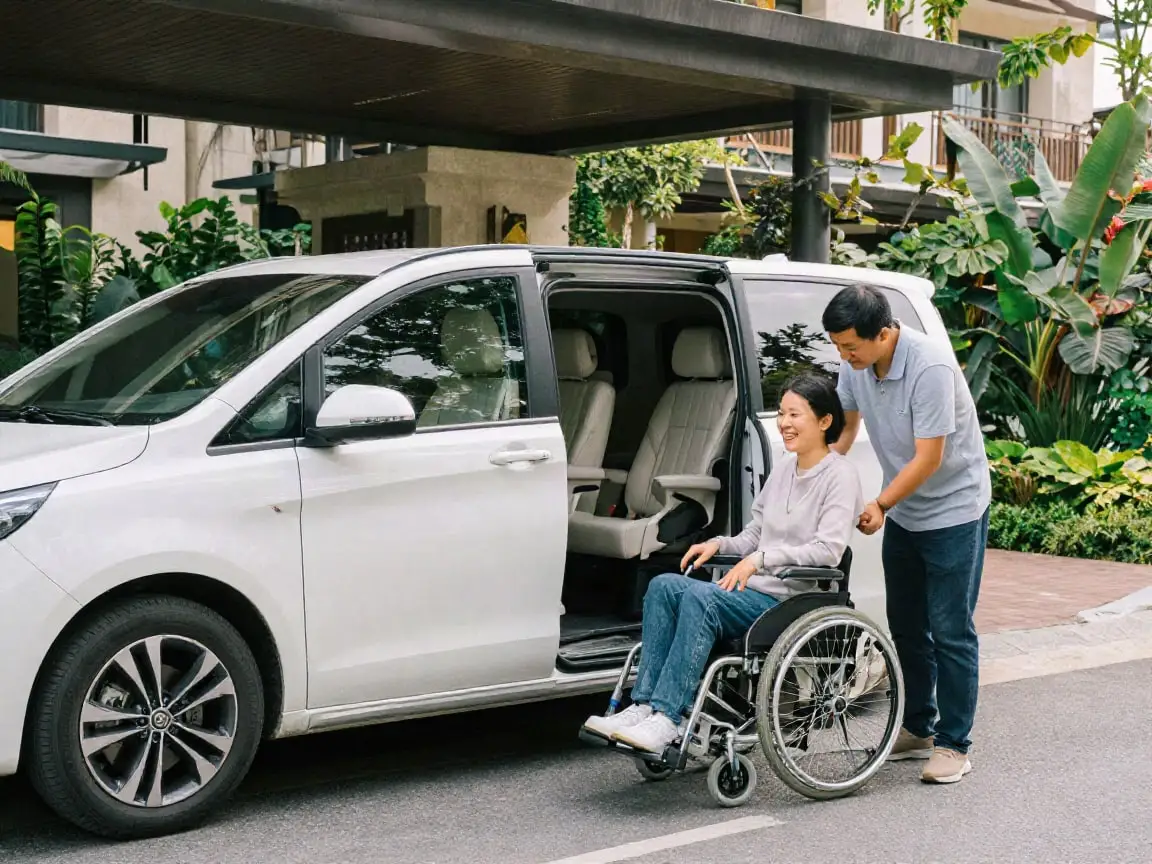
On the road
Vehicles matched to the chair, not the category.
An ‘accessible car’ can mean anything from a high-roof van with a lift to a sedan with a large boot. We confirm the specific vehicle for each transfer.
- Ramp length or lift platform size checked against your chair.
- Four-point wheelchair tie-downs and a lap-and-shoulder belt when you travel seated in your own chair.
- Door and interior height measured against your seated height in the chair.
- Drivers briefed on how you transfer, with time allowed for loading at every stop.
Wheelchair-accessible vehicles are limited in some cities, so we confirm early. See airport transfers, cabs and stays for how each is booked.
Airline assistance codes
The short codes that move the right help.
Airlines record assistance and meal requests as four-letter special service request (SSR) codes. Knowing which applies helps you check that your booking says what you need.
| Code | What it tells the airline |
|---|---|
WCHR | Wheelchair for distances to and from the aircraft. You can manage steps and move about the cabin. |
WCHS | Wheelchair to and from the aircraft, and help with steps. You can walk to your seat. |
WCHC | Wheelchair to and from the aircraft and help to and from your seat. You cannot walk unaided. |
WCMP | You travel with your own manual wheelchair. |
WCLB | Your wheelchair or scooter has a lithium-ion battery. |
WCBD | Your wheelchair has a non-spillable dry or gel battery. |
WCBW | Your wheelchair has a spillable wet-cell battery. |
BLND | Blind or vision-impaired passenger. |
DEAF | Deaf or hard-of-hearing passenger. |
DPNA | Passenger with an intellectual or developmental disability who needs assistance. |
SVAN | Service animal travelling in the cabin. |
MEDA | Medical case: the airline may need medical clearance, often through a medical information form (MEDIF). |
Codes are standard across most airlines, but the help provided and the notice required vary. We confirm with the airline for your route. Travelling for treatment? See medical travel, and recovery and return for flying home after a procedure.
Accessible travel FAQ
Access questions, answered with specifics.
What do WCHR, WCHS and WCHC mean on a flight booking?
They are the standard airline codes for wheelchair assistance. WCHR means you can manage steps and move about the cabin but need a wheelchair for longer distances to and from the aircraft. WCHS means you cannot manage steps but can walk to your seat. WCHC means you cannot walk and need help to and from your seat. The right code tells the airport which equipment and staff to arrange.
Can I take my own wheelchair or mobility scooter on a flight?
Usually, yes. Many airlines carry mobility aids in addition to your baggage allowance, but battery-powered chairs and scooters need advance notice, often at least 48 hours, with the battery type, watt-hour rating, dimensions and weight. Policies differ by airline, so we confirm acceptance and handling before you book.
How do you check that a hotel is really accessible?
We ask the property for measurements and photographs of the route from drop-off to the room, door widths, the bathroom layout, shower access and bed height, and we record who confirmed them and when. Critical details are re-confirmed close to travel, and if something cannot be verified, we tell you plainly.
Is my access profile shared automatically with airlines and hotels?
No. The profile is stored only in your browser until you choose to share it with an advisor or attach it to a booking. Each supplier then receives only what it needs: an airline gets the assistance and meal codes, a hotel gets the room requirements.
Can I travel with a carer or companion?
Yes. We book seats and rooms together and brief suppliers on the support your companion provides. Some airlines ask that passengers who cannot manage certain needs on board travel with a companion, and whether a companion fare exists varies by airline, so we check the rules for your route.
What if my disability is not visible?
Tell us what helps: extra time, quieter spaces, help with queues or written instructions. Many airports recognise the Hidden Disabilities Sunflower lanyard, and airlines can note assistance needs on your booking. You never need to share a diagnosis, only the support that would make the journey easier.
Access advisors
Tell us what access means for you. We check every leg.
Share your profile with an advisor when you are ready. Each supplier receives only the part it needs, and nothing is booked on an unverified label.